Museum of Art, Architecture and Technology (MAAT), Lisbon
Architect: AL_A (Amanda Levete Architects)
Year: 2016
Location: Lisbon, Portugal
Category: Cultural / Museum
Status: Built
About
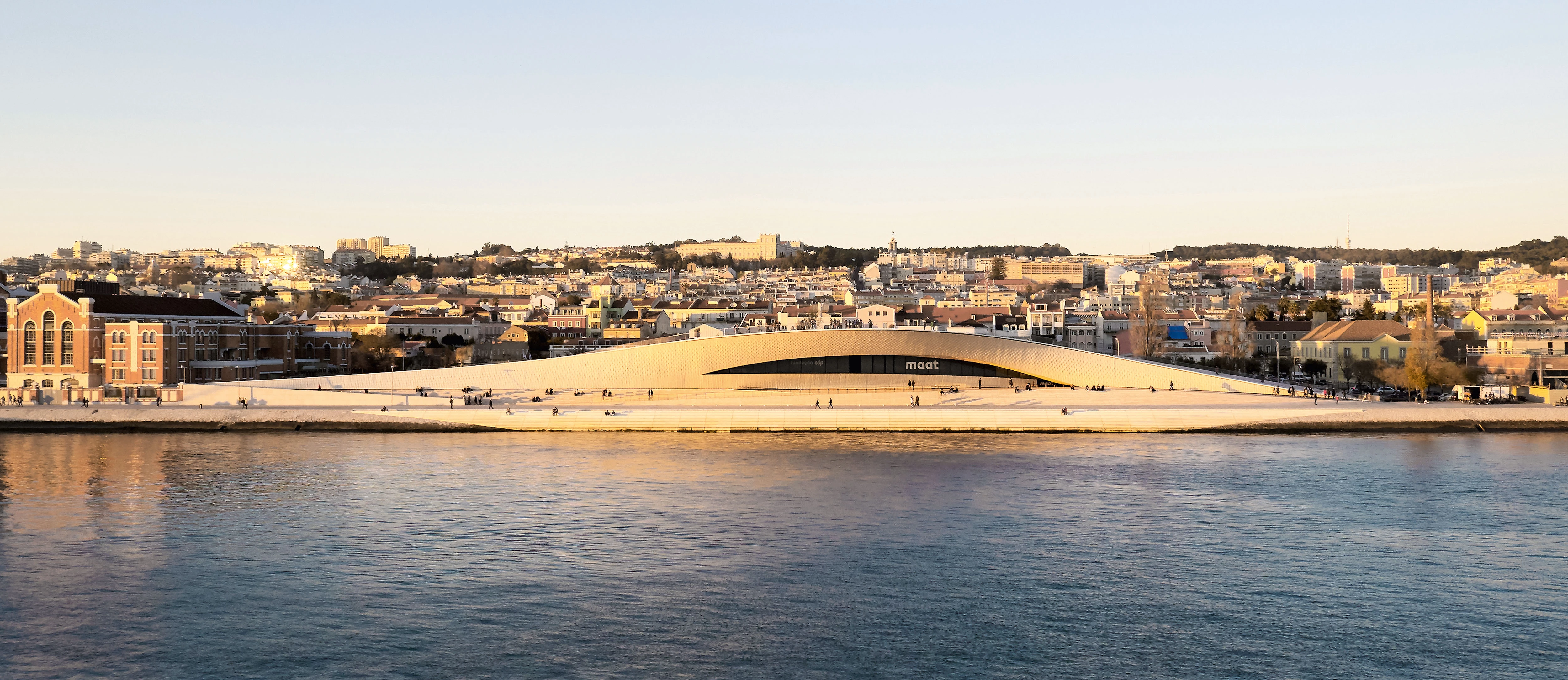
The cultural centre as landscape has become a recurrent trope of late. We find Frank Gehry doing it in Paris with his Fondation Louis Vuitton, a glass-and-stone hillock you can climb up to enjoy the Bois de Boulogne’s tree canopy; or, across town, there’s Jean Nouvel making a mountain out of his Philharmonie, complete with a cave, in a nod to the anti-Tschumi park that is the nearby des Buttes-Chaumont; and before either of them there was Snøhetta, in Oslo, turning a commission for an opera house into a glacier you can walk up or (in an ideal world) toboggan down. Amanda Levete and her firm AL_A faced a similar waterside situation with the new addition to Lisbon’s Museu de Arte, Arquitetura e Tecnologia (MAAT), and it’s primarily as an accessible public space that the majority of visitors, those who choose not to enter the museum, will experience the 20 million euro edifice, on a spectacular site on the banks of the majestic River Tagus, in the Portuguese capital’s Belém district. MAAT is owned and run by the Fundação EDP, the non-profit social and cultural arm of Energias de Portugal (EDP, formerly Electricidade de Portugal), and is housed in two buildings: AL_A’s new Kunsthalle (commissioned by EDP CEO António Mexia in 2010) and the former Tejo Power Station just next door. A splendid brick-and-steel cathedral of thermo-electricity built between 1908 and 1951, the power station closed in the 1970s, and initially opened to the public in 1990 as an electricity museum. Now, however, with the creation of MAAT, it also contains a large amount of whitecube gallery space, installed by director Pedro Gadanho, who left MoMA to head MAAT in 2015. EDP’s new institution joins a whole host of monuments and cultural sites in Belém, among which are the presidential palace, the monastery of the Jerónimos, the naval museum, Vittorio Gregotti’s Centro Cultural de Belém (1992) and Paulo Mendes da Rocha’s coach museum (2015). But all are cut off from the river by a major transport artery – eight traffic lanes and a railway – that stretches between the quayside and the inland residential district. At the time of writing, only two inadequate footbridges, a kilometre apart, span this formidable barrier.