University Children’s Hospital in Zurich (in project)
Architect: Herzog & de Meuron
Year: 2011
Location: Zurich, Switzerland
Category: Healthcare / Hospital
Status: Built
About
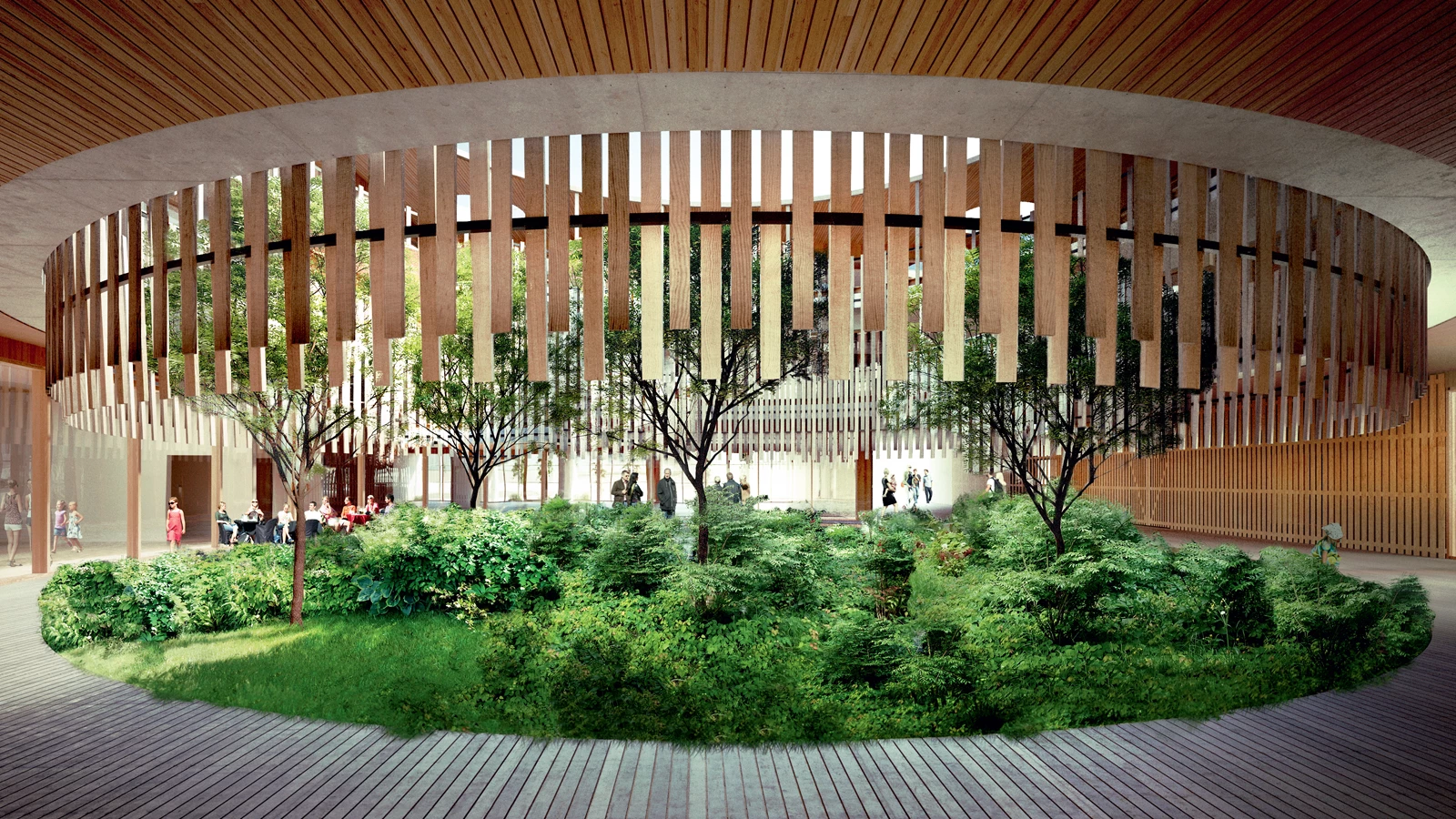
The present University Children’s Hospital, situated in Zurich’s city center, has already shown some limitations related with the lack of space and old infrastructure, thus calling for a new up-to-date expansion. The new hospital will be located near the city boundary occupying a greenfield site among other healthcare institutions. The scheme comprises two new buildings: an acute hospital on the southern site and the laboratory, teaching and research building on the northern site. The new acute hospital is a three-story filigree building arranged around numerous internal courtyards that fits the rural setting and responds to the historic Burghölzli Psychiatric Hospital located opposite the street, a 1869 listed building designed by Johann Caspar Wolff. A spacious forecourt in between them will serve as an access plaza for both institutions. Its horizontal emphasis also stands in stark contrast to the often oppressive or even intimidating hospital and ward blocks. The longitudinal facades are curved, with a concave geometry that embraces both the plaza and the hospital garden in the back. The program is organized in three levels, from the ground floor with the most public and frequented areas, to the most private part of the hospital on the top floor. The interior resembles a grid city organized around 16 internal courtyards that facilitate orientation and provide daylight. Each story has a main street and numerous side streets, alleys and squares, rhythmically configured and widening out at many points to accommodate waiting areas. The courtyards introduce an order into the grid, with the circular ones positioned along the open circulation spaces where key functional units open off the boulevards; the rectangular ones, on the other hand, adjoin the rows of cellular rooms that serve the relevant departments. The facade is a lattice of various materials: concrete, wood, textiles and plants. On the ground floor, permeable timber-board walls are used to form small loggias in front of each room, creating a visual barrier that maintains the privacy of the exposed indoor spaces. Located on the northern site, the laboratory, teaching and research building, by contrast, is a compact stand-alone volume with a stacked program – auditoria, seminar rooms, a study center and clinical diagnostic laboratories – for use by the university hospital. The building’s round shape and disposition were selected with the aim of preserving the views of the landscape.