MINE Pavilion, Denver
Architect: Pezo von Ellrichshausen
Year: 2013
Location: Denver, United States
Category: Temporary
Status: Built
About
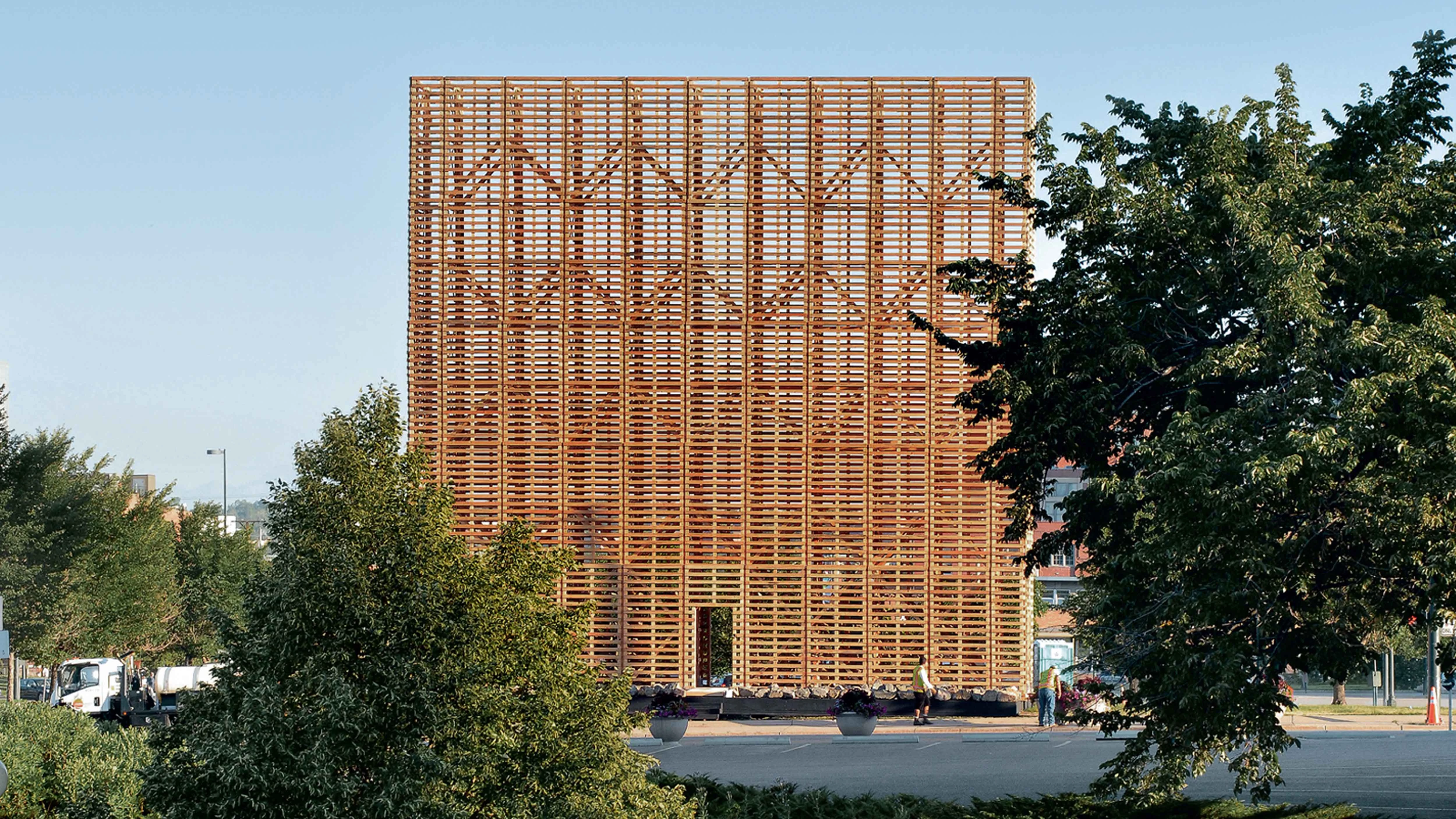
This asymmetrical artifact investigates the architectural notion of scale. It is a wooden structure that has been assembled according to a simple principle of gravitational stacking of elements that reduce their size in height. This structural logic can be read as an explicit acknowledgment of the classical rule of ‘entasis.’ The five-story wooden piece has been built as a sequential transition that turns a square module in section in half its width without altering the sense of unity, of a single entity, of the whole piece. This wooden object introduces a brief sculptural presence to a conflictive spot in between two consolidated areas of the urban fabric. The narrow and slender format of the building defines both a double character and a double speed in its urban setting: approaching by car from the four lanes of the boulevard the piece can be perceived as a translucent billboard; approaching as a pedestrian from the historical center of the city it can be perceived as a dense tower. The pavilion has no foundations but an extra load in lateral shelves and platforms given by ten tons of granite boulders. The stones not only define the immediate natural landscape of the pavilion but also evoke the mining crafts in the very foundational site of the city.